Window Balance Repair
A window that slams shut, drops like a trap, or takes two hands to lift hasn't worn out — its balances have. We identify the type, match the rating, and swap the part. The window stays; the propping stick retires.
replacement
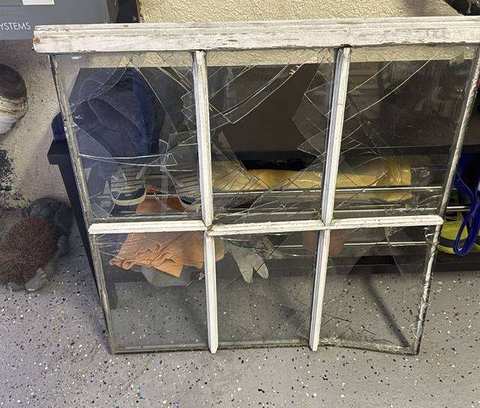 Before
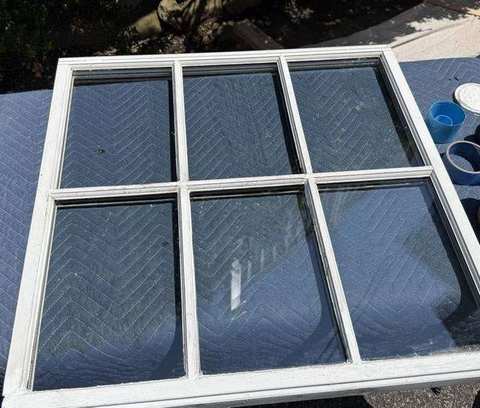 After
AfterGravity didn't used to win.
Here's what changed.
A double-hung sash weighs more than most people expect — often fifteen to twenty-five pounds of wood or vinyl and glass — yet a working window lifts with two fingers and hangs motionless at any height. That effortlessness is engineered: hidden on each side of the sash, a balance pulls upward with almost exactly the sash's weight, cancelling gravity out. When homeowners in Wayne or Westfield tell us a window "got heavy," "won't stay up," or "slams like a mousetrap," they're describing the moment that hidden equilibrium failed. Nothing about the window they can see has changed — which is exactly why the failure feels so mysterious, and why it so often gets misdiagnosed as a window problem instead of a part problem.
The symptoms, decoded
- Won't stay open at all — both balances have failed or detached. The sash is dead weight. This is the classic end state, and the most urgent: a window held up by nothing is a window waiting to drop on fingers.
- Slides down slowly — the balances still pull, but below the sash's weight. Spiral balances losing tension produce exactly this creep.
- Slams from halfway — one balance has let go completely; the survivor holds the top of the travel but surrenders below. Often the sash also sits crooked in the frame.
- Heavy going up, fights you coming down — a seized or wrongly rated balance. Common after universal-fit hardware-store balances go in without weighing the sash.
- Clunks, scrapes, or zips inside the jamb — the sound of a snapped spiral rod, a frayed block-and-tackle cord recoiling, or a shoe jumping its track. The failure has announced itself; the drop comes next.
Each symptom maps to a specific mechanical state, which is why a thirty-second video of the window misbehaving is worth more to us than a paragraph of description. Text one to (973) 564-0958 and you'll usually get the diagnosis — type, likely failure, realistic cost — the same day.
Why we replace balances in pairs
A sash rides two balances, one per side, installed the same day and aged by the same years of use. When one fails, its partner has the same mileage — and worse, it has spent recent months carrying loads it was never rated for while compensating for its dying twin. Swapping only the failed side puts a fresh spring opposite an exhausted one, which leaves the sash lifting unevenly, cocking in its channels, and wearing the new part prematurely. So we replace in pairs, always, and we'll check the neighboring windows while the tools are out. It's the difference between fixing the symptom and servicing the system — and it's why our balance work can carry a 5-year workmanship warranty without us losing sleep.
Repair thinking, applied to hardware
Balance failure is where the replacement industry does some of its easiest selling. The homeowner experiences a window that objectively doesn't work; the salesman doesn't have to invent a problem, just inflate the solution. But the arithmetic never favors the pitch: the failed component costs a small fraction of one replacement window, let alone the $23,000+ a whole-house project commands — and the new windows come with their own balances, running on the same clock that just expired in yours. Homeowners from Maplewood to Wayne have kept sound windows for decades by servicing hardware as it wears. That's the whole philosophy of this company applied at its smallest scale: fix the part that failed, leave the rest of the window — and your budget — alone.
Window balance repair & replacement across Wayne, Westfield, Maplewood & northern NJ · Based in West Caldwell · Mon–Fri 8:00 AM – 6:00 PM · (973) 564-0958
The whole-house replacement pitch that follows a stuck-open showing — quoted to homeowners whose windows needed a pair of balances per sash.
New windows, same old hardware clockBalances matched by type, length, and weight rating, installed in the existing jambs — 80% less than replacing the windows, with a 5-year workmanship warranty.
Opens with one finger, stays putThree steps between you
and a window that stays open.
Show us the symptom
A photo of the open jamb channel or a video of the sash dropping tells us the balance family and likely size before we ring the doorbell.
Answer same dayMeasure & match
Onsite we pull a balance, measure length and travel, weigh the sash, and confirm the correct rating — the step skipped by every universal-fit kit.
Within 1–2 daysSwap & verify
New balances in both channels — always in pairs — then we cycle the sash through its full travel and check the lock alignment before we call it done.
1–2 weeksPrefer to talk first? Call (973) 564-0958 — Mon–Fri, 8 AM–6 PM.
Three balance systems,
one diagnosis.
Every double-hung made in the last seventy years uses one of three counterbalance designs. Each fails in its own way — and each is a stock repair for us.
Spiral balances live inside slim tubes in the jamb channels: a twisted rod rides a spring, and the spring's tension carries the sash. They fail by losing tension gradually — the window gets heavier over months, then one day won't stay up at all. Spirals can sometimes be re-tensioned, but a spiral old enough to slip is usually a spiral worth replacing, since the spring has taken a permanent set. Block-and-tackle balances use a small pulley stack and cord inside a metal channel, multiplying a compact spring's force; they fail abruptly when the cord frays through or a pulley cracks — the classic one-day-fine, next-day-guillotine pattern. Constant-force balances are coiled steel ribbons that deliver the same pull at any height, common in newer vinyl and tilt-in windows; the coils fatigue and snap at the mounting drum.
The diagnosis matters because the fix is type-specific — the wrong family simply won't mount in your jamb, and the right family in the wrong rating turns a light window into a heavy one. It also matters because one failure predicts the next: balances age as a fleet, so we'll tell you honestly which other windows in the house are running on borrowed time. If your windows predate balances entirely — cords, pulleys, and cast-iron weights — that's the weight-pocket system, and it's repaired rather than replaced: see window sash repair. And if the sash drops because a spring in a newer window let go, the dedicated page is window spring replacement.
Matched by type, length, and sash weight — installed in pairs, tested through full travel.
The questions behind
every propped-up window.
My window slams shut the second I let go. Is the window broken?
No — one specific part inside it is. A sash that won't hold its position has lost its counterbalance: the hidden mechanism that offsets the sash's weight so it floats wherever you leave it. In a modern double-hung that mechanism is a balance — a spiral rod, a block-and-tackle cartridge, or a constant-force coil tucked into the jamb on each side of the sash. Balances are wear parts with finite service lives, and when one gives out, gravity wins. The glass is fine, the frame is fine, the sash is fine; the window needs a part, the way a car with a dead battery needs a battery. We identify the balance type from a photo or a short video, bring correctly rated replacements, and the window holds position again the same visit in most cases. A window slamming shut is also a genuine pinch and glass-breakage hazard — especially with kids around — so it's worth fixing promptly rather than living with the propping stick.
How do I know which balance type my windows have?
Open the window a few inches and look into the side channels. A spiral balance shows itself as a slim metal or plastic tube with a twisted rod emerging from the bottom, hooked to the sash's lower corner. A block-and-tackle balance looks like a rectangular metal channel with a visible cord and a small pulley stack inside, usually clipped to a shoe that rides in the jamb. A constant-force balance is a coiled steel ribbon, like a tape measure spring, mounted in a small drum near the top of the jamb. And if your house is pre-war, you may have none of these — look instead for small pulleys at the top of the frame and cords running down each side: that's the original weight-and-cord system, a different repair covered on our window sash repair page. You don't need to get the identification right — that's our job. A phone photo of the open channel answered the same day settles it.
Can you find balances for old or discontinued window brands?
Almost always. Balance manufacturing is more standardized than window branding suggests — a relatively small number of balance makers supplied most of the window industry, so a "discontinued" window usually contains a very findable balance. What matters is matching three things: the type (spiral, block-and-tackle, constant-force), the length, and the weight rating, which must correspond to the actual weight of your sash — a balance rated too light won't hold the window up, and one rated too heavy makes it fight you on the way down. We measure and weigh rather than guess, and we source from the suppliers who stock legacy sizes. In the rare case where nothing matches, there's nearly always a cross-compatible modern equivalent that fits the same channel. What we don't do is tell you the window can't be fixed because the brand is gone — that line has sold a lot of unnecessary replacement windows in New Jersey.
Is it worth repairing balances, or should I just replace the windows?
Run the numbers and the question answers itself. Balance replacement is a parts-and-labor repair measured in hours; whole-house window replacement in our area starts around $23,000. The windows themselves — frames, sashes, glass, the parts that actually cost money — are typically in fine condition; only the hardware has aged. Replacing a house full of windows because the balances wore out is like replacing a car because the shocks did. Our balance work runs roughly 80% less than replacing the affected windows, carries a 5-year workmanship warranty, and restores the thing you actually wanted: windows that open easily, stay open, and close without a fight. If we find a window where the wood genuinely is past saving, we'll say so plainly — but across Wayne, Westfield, and Maplewood, the overwhelming majority of "bad windows" we're shown are good windows with tired balances.
How fast can you fix a window that won't stay open?
The rhythm is the same as all our work, and balance jobs sit at the fast end of it. Text a photo or short video of the window to (973) 564-0958 and you'll have an answer the same day — usually including the likely balance type. Onsite assessment happens within 1–2 days; if the needed balances are common sizes, repair and assessment can be the same visit. Special-order balances add sourcing time, but the full job still completes within 1–2 weeks. We work Mon–Fri 8:00 AM – 6:00 PM, the crew is fully insured, and while we're in the channels we'll check the rest of the house's windows on request — balances installed at the same time tend to fail around the same time, so catching the next two before they drop saves a second trip.
More ways a good window
acts broken.
Send us a photo — get a real answer today
Tell us what's going on and attach a picture of the damage. We'll tell you honestly whether it's rot, whether it can be repaired, and roughly what it costs.
The stick in the window frame
has done its last shift.
Video the drop, text it over, and get a same-day answer naming the failed balance and the cost to swap it. It is a part — not a project.