French Door Repair
A pair of French doors is a precision instrument: two wide leaves, a shared astragal, dozens of glass panes, and one sill catching everything the weather sends. When the pair stops meeting cleanly, the instrument needs tuning — not throwing out.
Text us a photo of the doors — get an answer todayreplacement
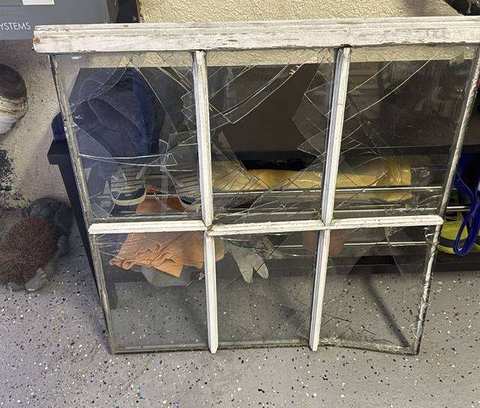 Before
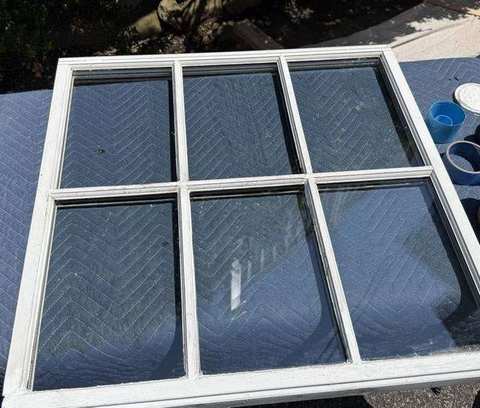 After
AfterFour parts do all the failing.
We repair all four.
French doors fail at the same four places on almost every house we visit, whether the pair opens onto a Maplewood garden or a Summit patio. Knowing the four is half the diagnosis:
- The hang — wide, glass-heavy leaves sag on their hinges until the pair collides at the top and gaps at the bottom; latches stop reaching keepers
- The astragal — the center meeting strip splits, its flush bolts loosen, and the seam between the leaves starts leaking air, light, and rain
- The glass — individual divided-lite panes crack, glazing putty crumbles, insulated lites fog; each pane is replaceable on its own
- The sill — rain running down all that glass lands on one board; the sill and leaf bottoms are where French doors rot first
What almost never fails is the reason you love the doors: the leaves themselves — mortise-and-tenon frames of good wood built to be serviced. A replacement quote discards that wood to solve a hinge, a strip, a pane, or a sill. Our written scope prices the actual failure instead, and the difference is typically about 80%.
Two doors that must agree
with each other.
A single door only has to fit its frame. French doors have to fit the frame and each other — the reveal between the leaves is the tightest tolerance on the wall, and every hinge adjustment on one leaf moves it. Repair means tuning the pair as a system.
That system logic runs through everything we do on a French door job. Realigning the sagged leaf comes first, because nothing else can be judged until the geometry is back. Then the astragal — rebuilt or refabricated to the original profile, bolts re-mortised — so the pair has a sound spine to close against. Then seals and latches, adjusted so both leaves pull tight without slamming. Rot work at the sill happens under all of it, restoring the level base both leaves are measured from. Do those in the wrong order and each fix undoes the last; do them in the right order and a forty-year-old pair closes like the day it was hung.
Interior pairs — the glass doors between a living room and a study — get the same treatment minus the weather details; they're one of the jobs covered on our interior door repair page. Exterior pairs on older and landmark homes often deserve the full restoration approach on our historic door restoration page, where matching original profiles and hardware is the point. And for the broader family of entry and back doors, start at exterior door repair.
Geometry first. Details second.
Photos of the pair
Shoot the doors closed from outside, the center seam top to bottom, and any soft wood at the sill. That's usually enough for a same-day read.
Answer same dayAssessment as a system
We check hang, astragal, glazing, seals, and probe the sill — then write one scope for the pair, in the order the work must happen.
Within 1–2 daysTune, rebuild, glaze, seal
Leaves rehung true, astragal rebuilt, panes replaced, sill rot repaired in place — finished with our 5-year workmanship warranty.
1–2 weeksRather talk it through? Call (973) 564-0958 — Mon–Fri 8:00 AM – 6:00 PM.
Questions asked with
both doors open.
My French doors won't meet in the middle anymore. What happened?
The leaves sagged — the predictable fate of two wide, glass-heavy doors hanging on opposite jambs. Each leaf carries a lot of weight far from its hinges, so over the years the free-swinging corners drop toward each other and the once-crisp gap at the middle turns into a collision at the top and a wedge of daylight at the bottom. The fix starts at the hinges: worn knuckles and stripped screw holes let the leaf lean, so we rebuild the screw holes with solid wood, reset or upgrade the hinges, and bring each leaf back to plumb. Then we true the meeting edges so the pair closes with an even reveal. Planing the doors to fit their sag — the shortcut some handymen take — permanently disfigures the leaves to accommodate a fixable problem. We fix the problem.
What is the astragal, and why does everyone keep pointing at mine?
The astragal is the vertical strip where the two leaves meet — usually mounted on the edge of the "fixed" leaf — that closes the gap between the doors, gives the active leaf something to latch into, and carries the weatherseal down the center of the pair. It's the hardest-working stick of wood on a French door and the first thing to fail: it gets slammed against for decades, its flush bolts chew their mortises loose, and on exterior doors it takes weather on the seam where rain runs. A worn or split astragal means drafts, rattling, and doors that won't stay latched. We repair or fabricate astragals to match the original profile, re-mortise the bolts into sound wood, and renew the seals — a focused repair that transforms how the whole pair closes.
One pane of glass cracked. Do I have to replace the entire door?
No — and on a true divided-lite French door, this is one of the most contained repairs in our trade. Each small pane sits in its own wood frame of muntins, bedded in glazing putty or held by wood stops. We cut a matching pane, remove the broken one, and glaze the new glass in place; the other panes and the door itself are untouched. If your door has insulated (double-pane) lites instead, the failed sealed unit gets measured and replaced the same way — fog between panes is the usual symptom there. Either way, glass is a component, not a verdict on the door. If several panes are loose and the putty is crumbling generally, we'll tell you, and reglaze the door as a whole rather than pane by pane.
The wood at the bottom of my French doors is soft. Is that the end of them?
It's the beginning of a repair, not the end of the doors. The sill and the bottoms of the leaves are the wettest wood on the whole assembly: rain hits the glass, runs down through every muntin joint, and lands on the sill; splash-back off a patio or deck adds more from below. Decay typically starts at the leaf's bottom rail corners and the sill's ends. Our repair is surgical — cut out the decayed fiber, consolidate the surrounding wood with penetrating epoxy, rebuild profiles with structural fill or spliced-in matching wood, and re-establish the drainage details so water sheds instead of sitting. The same craft we use on rotted door frames applies here; when the frame and sill are the main casualty, see our rotten door frame and sill repair page for that side of the job.
What does French door repair cost, and how fast can it happen?
Almost always about 80% less than replacing the pair — and replacing French doors is expensive, because you're buying two fitted leaves, an astragal, hardware, and often custom sizing for an older opening. Repair scope varies: hinge and alignment work at the low end, astragal rebuilds and glazing mid-range, sill rot rebuilds at the top. You'll know your number quickly: text photos to (973) 564-0958 and get an answer the same day, with a free onsite assessment within 1–2 days and most repairs completed within 1–2 weeks. Every job carries our 5-year workmanship warranty; RotGone is fully insured and based in West Caldwell, Mon–Fri 8:00 AM – 6:00 PM.
More door craft, one click each.
Before you price a new pair —
price the tune-up.
Text photos of your French doors and get the honest math the same day: what the repair costs, what replacement would run, and which one your doors actually need.